
Trace Saginaw County Former Owners
No master list of past owners exists for Saginaw County. Instead, you rebuild the chain transfer by transfer. Start with the newest deed tied to the current parcel. Then find where that grantor acquired the land, and repeat the step. The legal description is your anchor. Names, street addresses, and PINs can all shift over the years. But the land itself keeps its identity in the recorded description.
| Transfer point | Grantor to grantee | Instrument | Reference to retain |
|---|---|---|---|
| Latest located transfer | Prior owner to current grantee | Warranty, quitclaim, survivor, or other deed type | Recorded date and document number |
| Prior transfer | Earlier owner to latest grantor | Deed or estate-related instrument | Liber/page or cited prior instrument |
| Earlier platted chain | Prior parties in the same lot | Deed paired with subdivision plat | Plat caption, lot, and block |
| Older unplatted chain | Prior parties for the tract | Deed-book entry | Section, township, range, and calls |
Treat any working table as a log, not a claim. Add a row only when an index entry and the deed itself are in hand. Two dates matter. The document date and the recorded date are both worth writing down. They often differ.
Walk Saginaw Deeds Backward
The Saginaw County Tapestry index searches by name, document number, type, recorded-date range, consideration, subdivision, lot, block, parcel, section, township, range, and quarter. Follow the vendor's convention for business names. Put a company name in the last-name field. A percent sign widens a text search.
- Start with the current SAGA or local assessor parcel card and copy its PIN and legal description.
- Find the latest deed, then record its grantor, grantee, dates, type, number, and prior reference.
- Search the grantor as an earlier grantee and narrow by date, PIN, subdivision, or section.
- Compare every legal description before adding that transfer to the chain.
- Repeat until the online results end, then ask for the older index or deed-book entry.
Expect duplicates. One instrument can return several rows. Every party gets indexed, so one deed can appear many times. The detail screen and the image are the real record of the transfer. Note name variants, trust terms, and company spellings in your search log as you go.
Read Saginaw Ownership Chain Terms
Keep each role straight and the chain reads clearly. A directory may hint at who lived at an old address. Only the land records place that person in the deed chain, though. A directory name alone proves residence, not title.
- Grantor
- The party conveying an interest in the deed being read.
- Grantee
- The party receiving that stated interest.
- Chain of title
- The linked sequence of instruments affecting the same land.
- Reverse index
- An index organized to locate grantors or conveyances out.
- Quitclaim deed
- An instrument conveying whatever interest the grantor has, without the covenants of a warranty deed.
A deed's type alone never tells the whole story of title. Survivor, estate, trustee, land-contract, and correction instruments often explain a change that a plain sale list overlooks. Read past the label.
Measure Saginaw Ownership Record Depth
County historical material puts the Register of Deeds index back to 1835. That figure describes the index, not the images. It does not promise that every early document appears online in Tapestry. The county does not state an earliest year for its online Saginaw deed images. Ask the recorder directly about older holdings.
Online is not the whole chain. When Tapestry ends, contact the Register of Deeds for the older index, film, deed book, or paper reproduction.
Saginaw County itself dates to 1835. Boundary shifts involving Bay County occurred in 1875. Another shift followed in 1881. These shifts can change which office holds an old tract's records. Keep the county and municipality exactly as the historic source gives them. Forcing a modern address onto an old tract only muddies the trail.
Crosswalk Saginaw Plats and PINs
Platted land traces through the recorded subdivision caption, lot, and block. Unsubdivided land runs on quarter-section, section, township, range, and metes-and-bounds calls instead. Spelling matters in Tapestry; match the county's subdivision name exactly. Its quarter search also rejects quarter-quarter notation, so keep those calls simple.
A parcel split can retire an old PIN. The legal description carries on in prior deeds. Under Saginaw guidance, child numbers keep the parent's four-digit original-parcel component. They add a new three-digit split sequence. Record former PINs beside each former owner. Then compare the land-division file, the plat, and the deeds. Do this before you join two chains together.
Bridge Old Saginaw Property Addresses
The Public Libraries of Saginaw local-history collection holds city directories from 1866 onward and newspapers on microfilm from 1853. County histories, atlases, and plat books round out the shelf. It is a strong bridge when an address stops matching.
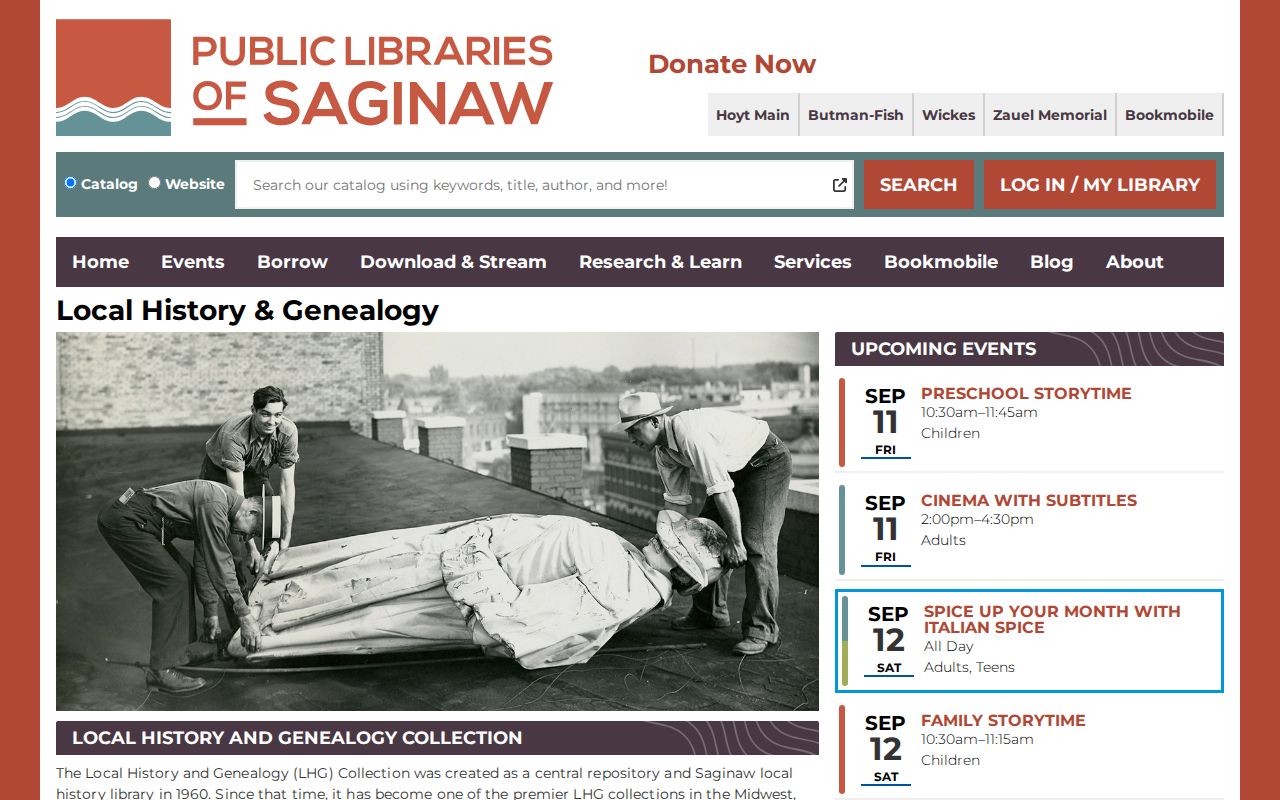
Most of the collection stays in the building and does not circulate. Staff will take questions remotely, and copying rules depend on the item. Remember what a directory proves. An entry shows a listed name at an address in that edition, nothing more; it does not establish a former owner on its own.
Test Saginaw Historic District Leads
City planning material names three historic district leads. These are Old Saginaw City, Heritage Square, and North Michigan. Old Saginaw City centers on South Michigan, Court, and River. Heritage Square is described around South Oakley, Court, South Harrison, and Mackinaw. These names help focus map and directory work.
A district name is not always a recorded subdivision caption, though. Search the present parcel number first. Then pin down the exact plat or section description and trace the instruments. That keeps a broad planning boundary from standing in. It should not stand in as the legal identity of every parcel inside it.
Reach Saginaw Former-Owner Records
The Register of Deeds search-request instructions ask for an owner name, the address, and an approximate purchase date. Requests go through Tapestry, email, phone, fax, or in person. The courthouse keeps a free public workstation. Over-counter searching is listed at $5. Copies run $1 per page. Certification is $5 per document.
Find the office at 111 S. Michigan Avenue, Saginaw, open weekdays from 8:00 a.m. to 4:45 p.m. except holidays. Librarians can add historical context, but the Register of Deeds keeps the recorded chain. For copy and instrument details, see the Saginaw County deed records page.
Keep Saginaw Former Owners Accurate
Even careful research hits breaks. Name changes and entity transfers can interrupt a chain. So can survivor filings, probate, land contracts, quitclaims, and parcel divisions. Never drop an odd instrument just because it lacks the look of a sale. Log the gap, then test it against the next legal description.
Use the chain lawfully. Research prior owners for title diligence, estate work, or property history, never to track, harass, or target a living person.
In the finished chain, separate confirmed deeds from contextual clues and open questions. A missing online result proves nothing. Records exist that no index shows. Ask the custodian for the older index, film, or book, and cite the edition or reference you actually consulted.