
Read Saginaw County Tax Fields
Several keepers feed Saginaw County property tax records. SAGA gathers assessor and tax fields from Equalization, local assessors, and local treasurers. The City of Saginaw and Saginaw Township stand apart. They handle specified ownership and roll work with their own assessors. So the unit, roll year, and field label matter as much as the number itself.
| Field | What It Shows | Where |
|---|---|---|
| MBOR assessed | March Board of Review assessment field | SAGA report and local assessor |
| Final SEV | Final state equalized value shown for the roll year | SAGA report and assessing records |
| Final taxable | Taxable-value field used with applicable rates | SAGA report and local assessor |
| Tax history total due | Amount displayed as of the report's settlement date | SAGA tax section and treasurer |
| Delinquent-tax status | Real-property delinquency clue for a stated year | SAGA and County Treasurer |
Assessed, SEV, taxable, and sale price are not the same thing. Sale price is a fact from one transaction. An equalization ratio adjusts an entire property class. Neither converts a parcel card into an appraisal. SAGA also notes that its delinquent-tax section leaves out unpaid personal property, and its total-due figure depends on a settlement date.
SAGA Shows Three Roll Years
The SAGA FetchGIS parcel report shows current-year general information plus prior-year tables. Those tables include MBOR assessed, final SEV, and final taxable values for the last year and two years ago. Land value, improvements, acreage, zoning, sales, building facts, the tax description, delinquent-tax information, and tax history round out the report. Sales data alone will not settle an appeal.
A blank field means unknown, not zero. Record the municipality and source year before comparing amounts. When a City of Saginaw or Saginaw Township result conflicts with another source, rely on the local assessor contact SAGA lists. The old county Equalization search URL returns an error. SAGA, municipal BS&A, and direct assessor contact form the practical fallback chain.
Sales and building facts give context. They are not inputs to copy blindly into an appeal. Check living area, year built, acreage, class, and improved or vacant status against the subject property. A mismatch often explains why two nearby assessed values differ. Save the report date, because assessor and treasurer feeds refresh on different schedules.
Saginaw Publishes Current Ratio Reports
The Saginaw County Equalization reports page gathers the county's valuation work in one place. Its publications include tentative ratio studies, millage reports, certified tax rates, exemption summaries, top-taxpayer lists, and value-change tables. Current and prior editions sit side by side. That matters for anyone working with property tax records. A ratio factor belongs to the year it was certified. Pulling an old factor into a new tax year distorts the math on a parcel's assessed value.
The official report index lists every publication by name and year. Matching a ratio to the right tax year takes only a moment.
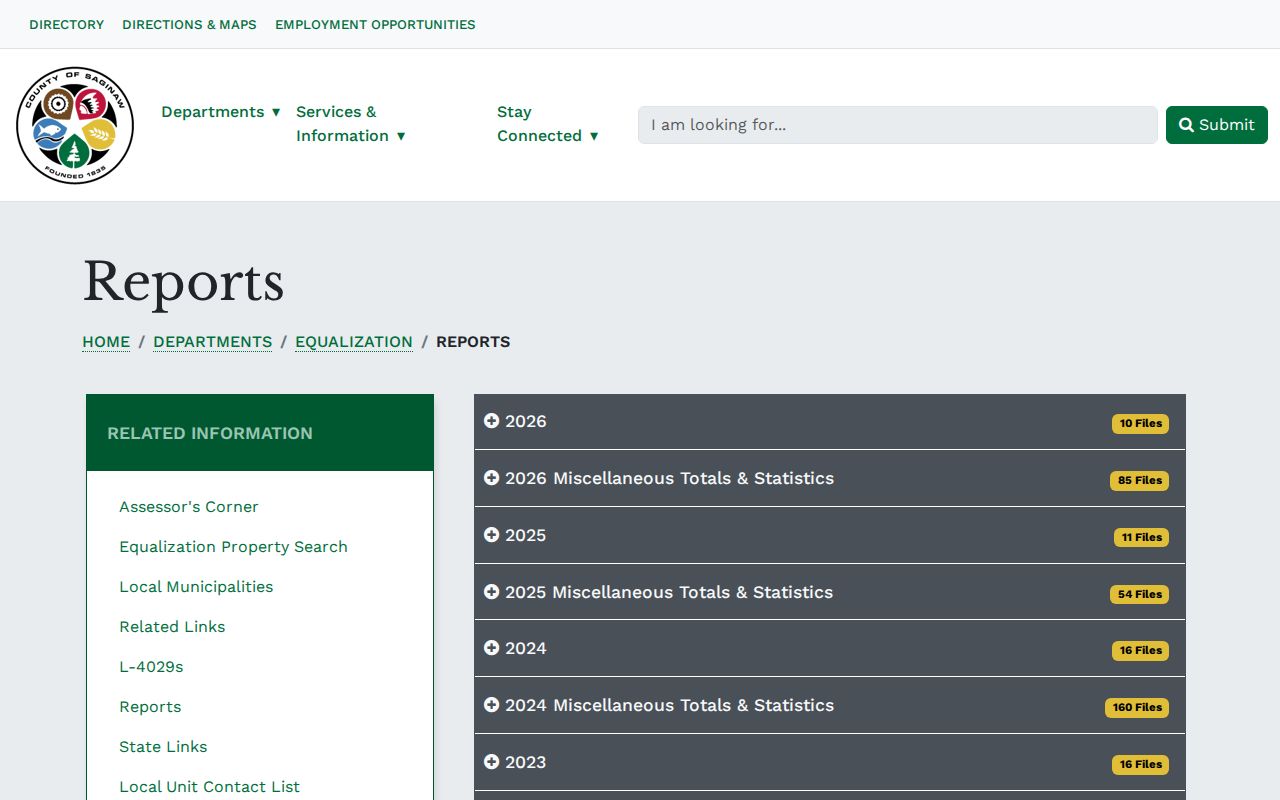
For countywide ratios and value-change context, the report list is the right source. A class ratio still says nothing about one parcel's value.
Take the 2025 tentative report. It gave separate residential, commercial, and industrial ratios for Saginaw, Frankenmuth, and Zilwaukee. Those figures belonged to those classes and that publication. The reports page now exposes newer material as well. Use the year named on the report. Never roll an older multiplier into a later parcel estimate.
Route Saginaw Taxes by Municipality
Ownership, address, and sales fields generally come from Equalization, SAGA says, except that the City of Saginaw and Saginaw Township use local assessors for specified work. Tax data come from local treasurers. That split explains why one countywide map can display fields produced by several public bodies.
The SAGA assessor directory routes questions to the right city or township. City of Saginaw assessing sits at 1315 South Washington Avenue, (989) 399-1311. Frankenmuth and Zilwaukee list their own contacts. Use the municipality field, not the ZIP code alone. A mailing area can cross a city line.
Date Every Saginaw Tax Number
Property tax records shift through an annual cycle, payments, corrections, exemptions, and parcel changes. Capture the tax year, roll label, settlement date, municipality, and source beside every amount. A current screen can still hold prior-year fields. An online payment may also post on a schedule that differs from an assessor update.
Date discipline prevents false foreclosure claims too. Delinquency is an account status at a point in time. A court index is only a lead to a case, and a recorded sheriff's or foreclosure deed is a separate instrument. Confirm each signal in its own system before linking them.
Look Up a Saginaw Tax Bill
A current bill starts in the municipality's tax system. Delinquent real-property tax questions move to the Saginaw County Treasurer. The county page exposes no stable search-field inventory, so do not guess at portal controls. Use the parcel number from SAGA. Keep the municipality and tax year with it. Confirm any balance before payment.
- Find the parcel by address in SAGA or the correct municipal BS&A system. Save the full PIN and unit name.
- Read the assessed, SEV, and taxable fields with their roll year. Check the tax-history settlement date.
- Use the local treasurer for the current bill. Use the County Treasurer's delinquent-tax page when the year has moved to county collection.
- Confirm the parcel and amount directly before paying. Search deed and court sources separately if foreclosure is at issue.
- Assessed value
- An assessor's value field for the stated roll year.
- State equalized value
- The final SEV field after equalization.
- Taxable value
- The value base used with applicable millage to calculate tax.
- Millage
- A tax rate expressed in mills and tied to a taxing unit and year.
- Tax lien
- A public claim arising from unpaid tax, distinct from a final foreclosure deed.
Pay Saginaw Delinquent Tax Carefully
The County Treasurer delinquent-tax page lists in-person service from 8:00 a.m. to 5:00 p.m. weekdays. It also lists mail to 111 South Michigan Avenue. Online G2G payment runs around the clock. Payment types vary by delinquency period. Online payment carries an enhanced access fee.
The county warns that a wrong-parcel payment may not be refunded. Match the entire parcel number, municipality, year, and owner field before sending funds. A correction redemption certificate is listed at $20. Tax certification for recording work is a separate Treasurer service.
Confirm before paying. A delinquent-tax field is dated account data, not proof of foreclosure, and the wrong parcel may not be refundable.
Keep Saginaw Tax and Title Apart
The tax-roll owner is an administrative field, nothing more. A newly recorded deed often reaches the record before the roll shows the change, and the county's exact update interval is not published. That lag matters when money is at stake. Before relying on the owner of record for a payment, exemption, or appeal, compare the displayed roll year with the newest deed recording date and document number.
Tax descriptions deserve similar caution. A brief tax description can help you identify the land, yet it never replaces the full recorded legal description on the deed. Parcel splits add another wrinkle. A division or combination can break the thread between old and new accounts, so retain both parcel numbers and compare the land descriptions when you trace a balance across the change.
Saginaw Tax-Sale Data Has a Gap
Saginaw County publishes no current public tax-sale roster, auction interface, redemption export, or stable tax-balance search form. The Treasurer's payment page is not a sale list. A delinquency entry does not prove foreclosure either. Nor does it prove the parcel was conveyed.
When the question goes beyond payment status, compare the tax year with later Register of Deeds instruments and the Odyssey court index. A lis pendens only gives notice of litigation. A sheriff's deed or foreclosure deed records the conveyance itself, and neither event should ever be inferred from a tax balance alone.
Saginaw Parcel Changes Affect Tax Trails
Splits change the map. Equalization's Assessor's Corner gathers land-division and land-combination forms, tax-payment certification, ratio reports, and assessor resources in one place. A split can retire a parent parcel number and create child PINs, so tax research that starts from today's PIN may miss the older account path.
Current forms route through the Assessor's Corner.
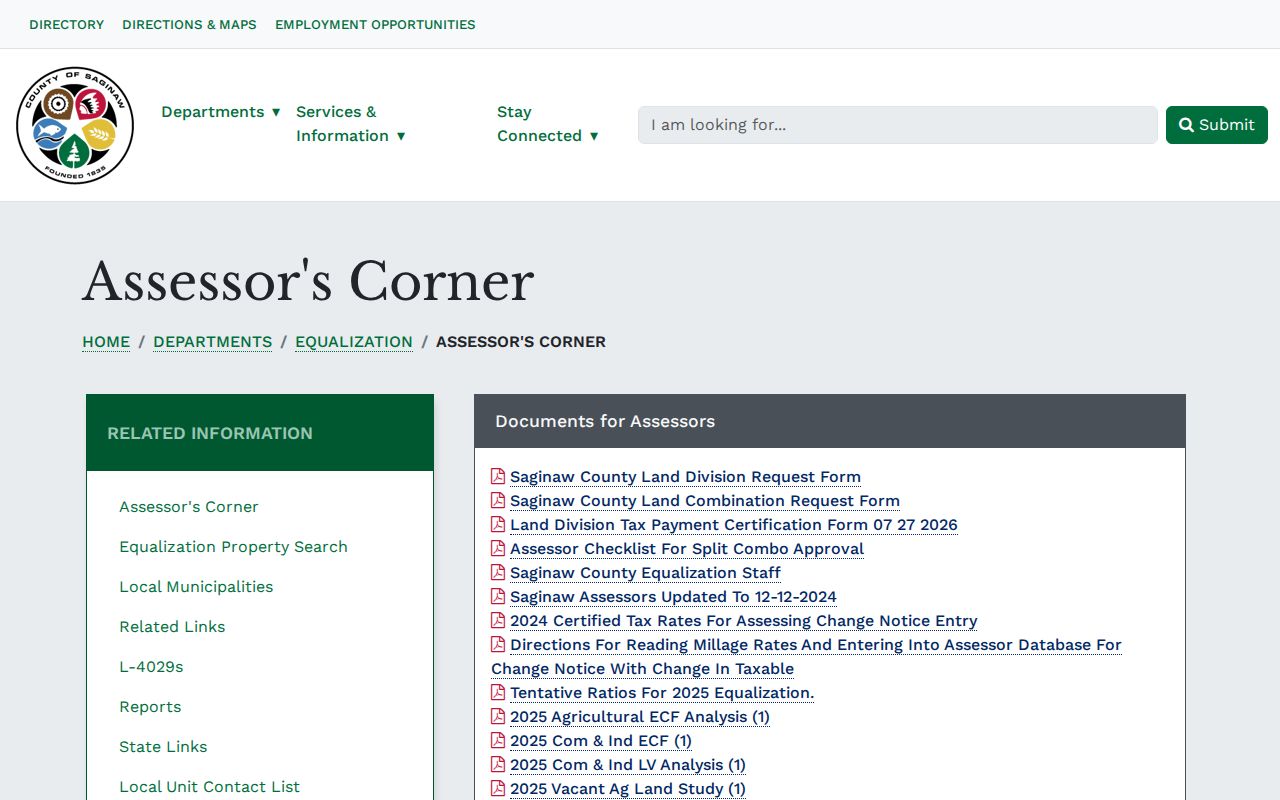
Keep the paper trail. Save the parent and child parcel identifiers along with the approval record, then check each affected tax year in the proper local system.
Contest a Saginaw County Assessment
Assessment review starts locally. Contact the assessor for the municipality shown on the parcel record. Equalization supplies the forms, ratio reports, and local assessor contacts, though the county sets no single filing deadline or appeal form for every unit. Read the current assessment notice closely. Then confirm your Board of Review schedule.
Good evidence keeps value types separate. Bring the notice, the parcel report, property facts, any relevant photos, and genuinely comparable sales with dates and characteristics. A deed consideration amount or one nearby sale never sets the assessed or taxable value by itself.
Appeal window. Saginaw County municipalities set their current Board of Review procedures. Read the notice and contact the local assessor promptly because no single verified countywide deadline was found.